Introduction
Getting consistent clients is one of the biggest challenges for a commercial cleaning company.
You can have great cleaners, competitive pricing, and excellent service—but if your sales pipeline is empty, your business will struggle to grow.
So how do you consistently find businesses that actually need cleaning services?
Lead generation.
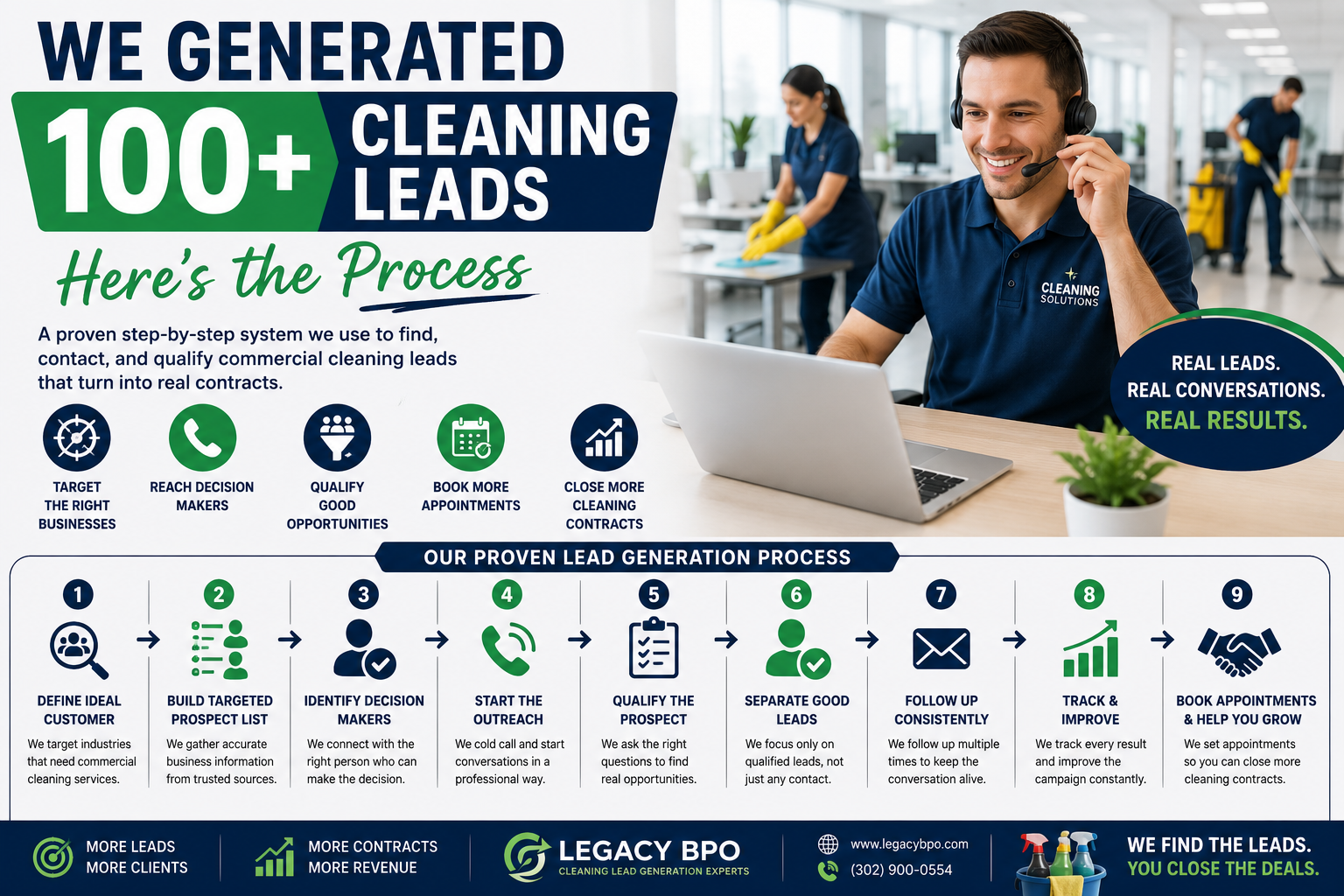
In this guide, we’re breaking down the process behind generating 100+ cleaning leads and how a structured outbound system can help cleaning companies build a predictable pipeline of potential clients.
The goal isn’t simply to make hundreds of calls.
The goal is to identify the right businesses, reach the right decision-makers, qualify genuine opportunities, and create conversations that can turn into commercial cleaning contracts.
What Makes a Good Cleaning Lead?
Before generating leads, you need to understand what you’re looking for.
A random business contact isn’t necessarily a valuable lead.
For a commercial cleaning company, a useful prospect typically has:
- A commercial facility
- A recurring cleaning requirement
- A potential need for professional cleaning services
- An identifiable decision-maker
- A service area that matches your business
- Potential budget for outsourced cleaning
For example, a small business with a two-person office may not be as valuable as a medical facility, school, warehouse, or multi-location office complex.
That’s why lead quality matters just as much as lead quantity.
Step 1: Define the Ideal Customer
The first step is deciding exactly who you want to target.
Instead of calling every business in a city, we create a target profile.
For example:
Target Market
Location: Selected U.S. cities and states
Industries:
- Office buildings
- Medical facilities
- Dental offices
- Schools
- Warehouses
- Manufacturing facilities
- Retail locations
- Restaurants
- Hotels
- Property management companies
Decision-makers:
- Facility managers
- Property managers
- Operations managers
- Office managers
- Business owners
- General managers
This allows the campaign to focus on businesses that are more likely to require commercial cleaning services.
Step 2: Build a Targeted Prospect List
Once the target market is defined, the next step is building a prospect list.
The list can include information such as:
- Company name
- Business address
- Website
- Industry
- Phone number
- Email address
- Contact person
- Job title
- Location
The more relevant information you have, the easier it becomes to personalize your outreach.
Instead of saying:
“We provide cleaning services. Are you interested?”
You can have a much more relevant conversation with the prospect.
Step 3: Identify the Decision-Maker
One of the biggest mistakes in cold outreach is talking to the wrong person.
A receptionist may answer the phone, but they may not be responsible for selecting a cleaning company.
That’s why identifying the right contact is important.
Depending on the business, the decision-maker could be:
Office → Office Manager
Warehouse → Facility Manager
Retail → Store Manager
Commercial Property → Property Manager
Medical Facility → Facility/Operations Manager
Manufacturing → Operations Manager
Getting to the right person can dramatically improve the quality of your conversations.
Step 4: Start the Outreach
Once the prospect list is ready, the outreach begins.
Cold calling is one of the primary channels because it allows you to have a real conversation with a potential client.
The objective isn’t to pressure someone into buying.
Instead, the conversation should determine whether there is a potential opportunity.
A simple opening might be:
“Hi, we’re reaching out to businesses in your area that may be reviewing their commercial cleaning services. I wanted to see who handles cleaning services for your facility.”
If you’re speaking with the right person, you can continue with qualification questions.
Step 5: Qualify the Prospect
Not every person who answers the phone becomes a lead.
This is where qualification becomes important.
We look for information such as:
Do they currently use a cleaning company?
If yes, there may still be an opportunity if their contract is ending or they’re unhappy with their current provider.
Are they considering changing providers?
A prospect actively considering a change can be highly valuable.
When might they need service?
Timing helps determine whether the opportunity is immediate or something that needs follow-up.
What type of facility do they operate?
Understanding the facility helps the cleaning company determine whether the opportunity fits its services.
Who makes the final decision?
This ensures the opportunity reaches the right person.
Step 6: Separate Leads From Unqualified Prospects
This is an important part of the process.
Generating 100+ conversations doesn’t necessarily mean generating 100+ qualified opportunities.
There is a major difference between:
Prospect → Contact → Interested Prospect → Qualified Lead → Appointment → Contract
A strong lead-generation campaign tracks these stages separately.
For example:
| Stage | Meaning |
|---|---|
| Prospect | Business that fits the target market |
| Contacted | Outreach has been attempted |
| Connected | Conversation occurred |
| Interested | Prospect showed interest |
| Qualified | Opportunity meets campaign requirements |
| Appointment | Meeting or walkthrough scheduled |
| Client | Contract successfully closed |
This prevents businesses from confusing activity with actual sales opportunities.
Step 7: Follow Up
One conversation isn’t always enough.
A prospect might say:
- “Call me next month.”
- “We’re currently under contract.”
- “Send me your information.”
- “Talk to my manager.”
- “We’re not looking right now.”
That doesn’t necessarily mean the opportunity is gone.
A structured follow-up system allows sales teams to stay in contact without becoming overly aggressive.
For example:
Day 1: Initial call
Day 3: Follow-up
Day 7: Second follow-up
Day 14: Check-in
Later: Reconnect when the timing is appropriate
The exact schedule should depend on the prospect and the sales process.
Step 8: Track Every Conversation
If you’re making hundreds of calls but not tracking the results, you’re leaving valuable information on the table.
A good campaign should track:
- Calls made
- Calls answered
- Conversations
- Decision-makers reached
- Interested prospects
- Qualified leads
- Appointments
- Follow-ups
- Closed deals
This data tells you what’s working.
For example, if one industry produces significantly more qualified opportunities than another, you can increase your focus on that industry.
Step 9: Improve the Campaign
Lead generation isn’t a “set it and forget it” process.
The campaign should continuously improve.
We can analyze:
Which industries respond best?
Which locations produce better opportunities?
Which opening scripts generate more conversations?
Which objections appear most often?
Which prospects are most likely to book an appointment?
Small improvements across the campaign can create significant differences over time.
So, How Do You Generate 100+ Cleaning Leads?
The answer isn’t one secret tactic.
It’s a system.
The process looks like this:
Target Market
↓
Build Prospect List
↓
Find Decision-Makers
↓
Cold Outreach
↓
Qualify Prospects
↓
Follow Up
↓
Book Appointments
↓
Help Cleaning Companies Win Contracts
That’s the foundation of a scalable commercial cleaning lead-generation system.
Why Consistency Matters
One of the biggest problems cleaning companies face is inconsistent sales activity.
They may receive several referrals one month and almost nothing the next.
A structured outbound campaign creates another source of opportunities.
Instead of waiting for the phone to ring, you can proactively reach businesses that may need your services.
This doesn’t guarantee that every prospect will become a customer.
But it gives your sales team something extremely valuable:
a consistent pipeline of opportunities to work.
What Happens After We Generate the Lead?
Generating the lead is only the beginning.
The cleaning company still needs to:
- Contact the prospect
- Understand the facility’s requirements
- Discuss services
- Provide pricing
- Schedule a walkthrough when appropriate
- Submit a proposal
- Follow up
- Close the contract
That’s why we focus on generating relevant and qualified opportunities, rather than simply producing a large list of random business contacts.
Want More Cleaning Leads?
If your cleaning company is spending too much time searching for prospects instead of closing contracts, a dedicated lead-generation campaign can help.
At Legacy BPO, we help commercial cleaning companies connect with businesses that may need professional cleaning services.
Our approach focuses on:
- Targeted prospect research
- Cold calling
- Decision-maker identification
- Lead qualification
- Follow-up
- Appointment setting
The goal is simple:
Give cleaning companies more opportunities to have conversations with potential clients.
Final Thoughts
Generating 100+ cleaning leads doesn’t happen because of one magic script or one marketing channel.
It comes from having a repeatable process.
Find the right businesses.
Reach the right decision-makers.
Start meaningful conversations.
Qualify the opportunities.
Follow up consistently.
Track the results.
Then improve the process.
For cleaning companies looking to grow, building a predictable lead-generation system can be one of the most important steps toward creating a stronger and more consistent sales pipeline.
More conversations create more opportunities—and more opportunities can lead to more commercial cleaning contracts.