Introduction
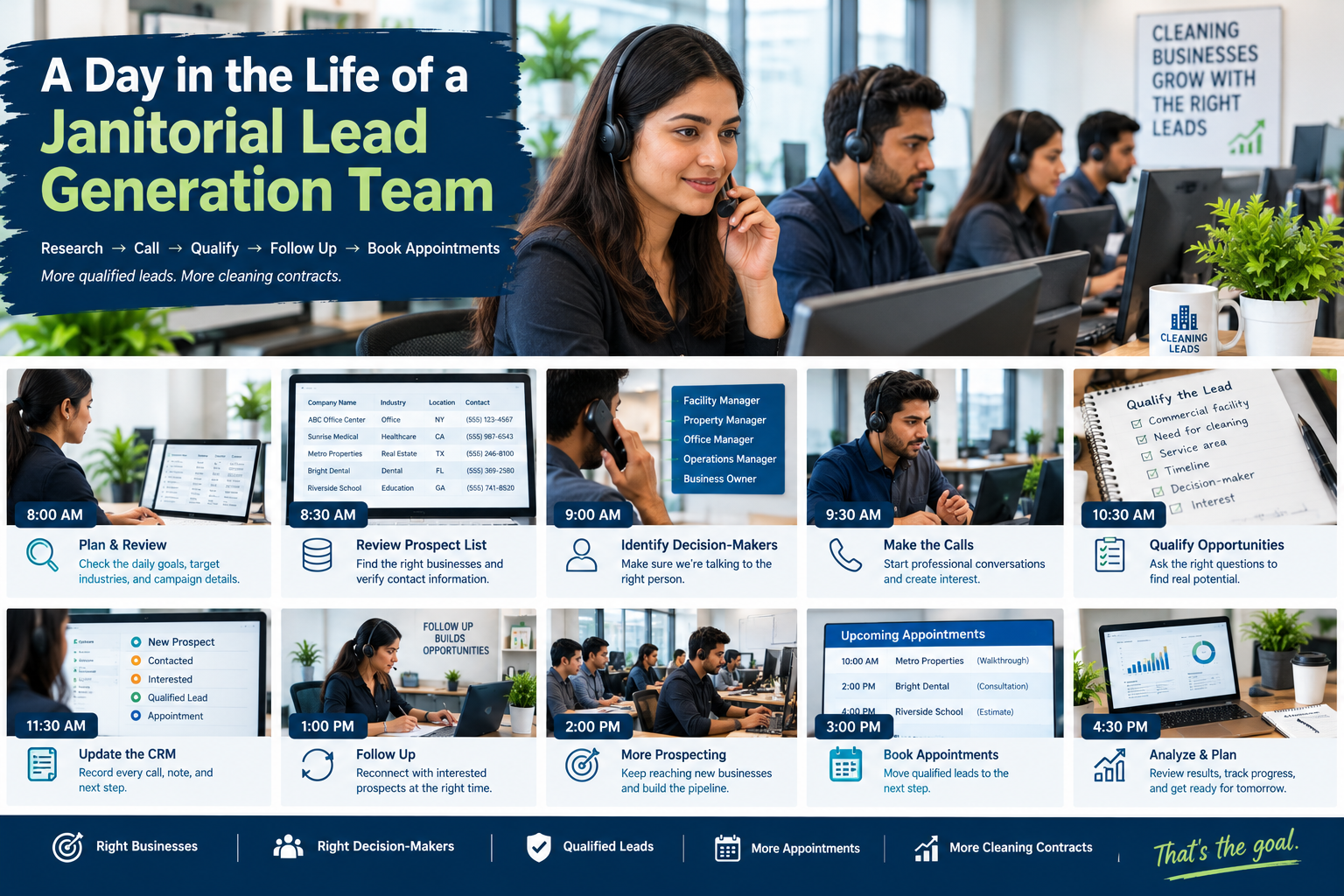
What does a typical day look like inside a janitorial lead generation team?
It’s much more than simply picking up a phone and making calls.
Behind every qualified cleaning lead is a process involving prospect research, contact verification, decision-maker identification, cold calling, qualification, follow-up, and data tracking.
For a commercial cleaning company, this work can mean the difference between having an empty sales pipeline and having a steady flow of potential clients to contact.
So let’s take a look at what happens during a typical day.
8:00 AM — Start With the Game Plan
The day starts by reviewing the campaign.
Before anyone starts making calls, the team checks:
- Target industries
- Target locations
- Prospect lists
- Previous conversations
- Scheduled callbacks
- Follow-up tasks
- Appointments
- Campaign goals
This helps the team understand exactly what needs to happen during the day.
For example, one campaign might focus on:
Commercial offices in Texas
while another might target:
Dental offices in Florida
The more specific the campaign, the easier it becomes to tailor the outreach.
8:30 AM — Review the Prospect List
The next step is reviewing the businesses we’re planning to contact.
A prospect list can include information such as:
- Company name
- Business location
- Website
- Phone number
- Industry
- Contact person
- Job title
- Previous contact history
- Follow-up date
The goal is to avoid making completely random calls.
We’re looking for businesses that fit the cleaning company’s ideal customer profile.
9:00 AM — Identify the Decision-Maker
Finding a business is only part of the job.
We also need to figure out who handles cleaning decisions.
Depending on the business, that could be:
- Facility Manager
- Property Manager
- Office Manager
- Operations Manager
- Business Owner
- General Manager
For example, if we’re contacting a large commercial property, the receptionist may not be the person responsible for hiring the cleaning company.
Finding the right contact can make the conversation much more productive.
9:30 AM — The Calls Begin
Now the real outreach starts.
The team begins contacting businesses that match the campaign criteria.
But the goal isn’t to make a robotic sales pitch.
The objective is to start a professional conversation.
A basic opening might sound like:
“Hi, I’m reaching out because we work with businesses in your area that may need commercial cleaning services. I wanted to find out who handles cleaning services for your facility.”
From there, the conversation can develop naturally.
10:00 AM — Handling Different Responses
Every call is different.
Some people may be interested.
Some may already have a cleaning company.
Some may ask for information.
Some may say they’re not interested.
Others may ask you to call back later.
That’s normal.
A good lead-generation team needs to be prepared for all of these responses.
The goal isn’t to force every person into a sales conversation.
It’s to identify whether there is a legitimate opportunity.
10:30 AM — Qualifying Potential Leads
When a prospect shows interest, the team begins asking qualification questions.
For example:
“Are you currently using a cleaning company?”
“Are you satisfied with your current service?”
“How often is the facility cleaned?”
“Are you considering changing providers?”
“When would you potentially need a new service?”
These questions help determine whether the prospect is actually worth pursuing.
11:30 AM — Recording the Results
Every meaningful conversation should be recorded.
The team may update information such as:
- Contact status
- Decision-maker name
- Current cleaning provider
- Level of interest
- Potential timeline
- Follow-up date
- Appointment status
- Notes from the conversation
Why?
Because the next person who contacts that prospect needs to know what happened previously.
Without accurate records, valuable opportunities can easily get lost.
12:30 PM — Midday Review
At the middle of the day, the team can review campaign performance.
For example:
Calls made
Conversations
Decision-makers reached
Interested prospects
Qualified leads
Appointments
This helps identify whether the campaign is moving in the right direction.
If one industry is producing better conversations than another, the campaign can be adjusted.
1:00 PM — Follow-Up Calls
Not every lead is ready to move forward during the first conversation.
This is where follow-up becomes extremely important.
A prospect may have said:
“Call me next week.”
Another might say:
“We’re reviewing our current contract next month.”
Another might ask:
“Can you send me some information?”
These prospects shouldn’t simply disappear from the pipeline.
The team follows up according to the agreed timeline.
2:00 PM — More Prospecting
After completing follow-ups, the team continues reaching new businesses.
This creates a balance between:
Finding new opportunities
and
Following up with existing prospects.
Both are important.
If you only make new calls, you may neglect warm opportunities.
If you only follow up, your pipeline can eventually become empty.
A healthy sales process needs both.
3:00 PM — Booking Appointments
When a prospect is genuinely interested and qualified, the next step may be scheduling an appointment.
Depending on the cleaning company’s sales process, this could be:
- Phone consultation
- Sales meeting
- Facility walkthrough
- Cleaning estimate
- Proposal discussion
The lead-generation team’s job is to help move the prospect to the appropriate next step.
The cleaning company’s sales team can then take over and work toward closing the contract.
4:00 PM — Update the Pipeline
At this stage, the team makes sure all important conversations have been recorded.
Each prospect should have a clear status.
For example:
New Prospect
Business has been identified but not contacted.
Contacted
Outreach has been attempted.
Connected
Conversation took place.
Interested
Prospect showed potential interest.
Qualified Lead
Opportunity meets the campaign requirements.
Appointment
Meeting or walkthrough scheduled.
Follow-Up
Prospect requires another conversation.
Closed
Cleaning company successfully won the business.
This organization helps prevent opportunities from falling through the cracks.
4:30 PM — Analyze the Numbers
Before the day ends, the team reviews performance.
Important numbers may include:
- Total calls
- Conversations
- Decision-makers reached
- Qualified leads
- Follow-ups
- Appointments
- Conversion rates
The purpose isn’t simply to celebrate a large number of calls.
It’s to understand what produced results.
For example:
If 100 calls generate only a few conversations, the targeting may need improvement.
If conversations are high but appointments are low, the messaging or qualification process may need adjustment.
If appointments are strong but contracts are low, the sales process may need attention.
5:00 PM — Plan for Tomorrow
The final step is preparing for the next day.
The team reviews:
- Scheduled callbacks
- New prospects
- Follow-up tasks
- Appointment schedules
- Campaign performance
- Priority prospects
This means the next day starts with a clear plan instead of starting from zero.
What Happens Behind Every Cleaning Lead?
When you look at a qualified lead, it might seem simple:
Business → Interested → Appointment
But behind that lead there may have been:
Research
↓
Prospect Selection
↓
Decision-Maker Identification
↓
Cold Call
↓
Conversation
↓
Qualification
↓
Follow-Up
↓
Appointment
That’s why professional lead generation requires a structured process.
The Team Isn’t Just Making Calls
A common misconception is that lead generation is simply:
“Make as many calls as possible.”
That’s not the whole picture.
A strong lead-generation team is also responsible for:
Research
Finding relevant businesses.
Data
Keeping prospect information organized.
Communication
Starting professional conversations.
Qualification
Determining which opportunities are worth pursuing.
Follow-Up
Maintaining relationships with prospects.
Scheduling
Moving qualified opportunities toward appointments.
Reporting
Tracking campaign performance.
This is why consistency and organization matter just as much as call volume.
What Makes a Good Janitorial Lead?
A good lead isn’t simply someone who answers the phone.
A strong commercial cleaning opportunity may have:
- A suitable facility
- A potential cleaning requirement
- An appropriate location
- A relevant decision-maker
- A realistic timeline
- Interest in discussing the service
- Potential fit with the cleaning company’s capabilities
The exact qualification criteria should be customized to the cleaning company.
Why Cleaning Companies Outsource Lead Generation
Many cleaning company owners already have enough responsibilities.
They may be managing:
- Employees
- Schedules
- Existing customers
- Supplies
- Equipment
- Quality control
- Invoicing
- Operations
Finding new clients can easily become something they do only when they have free time.
That’s a problem because sales activity needs consistency.
Outsourcing prospecting can allow the cleaning company to focus more on:
Operations + Service Quality + Closing Qualified Opportunities
while a dedicated team focuses on:
Research + Outreach + Qualification + Follow-Up + Appointment Setting
The Goal Isn’t Just More Calls
This is perhaps the most important lesson.
A successful lead-generation campaign isn’t necessarily the campaign with the most calls.
It’s the campaign that creates the right opportunities.
For example:
1,000 random calls
may produce fewer useful opportunities than:
500 targeted calls
to the right businesses and decision-makers.
That’s why we focus on quality, targeting, and consistency—not simply call volume.
A Typical Lead Generation Workflow
Here’s the process in simple terms:
1. Find
Identify businesses that fit the target market.
2. Research
Understand the company and its potential needs.
3. Identify
Find the relevant decision-maker.
4. Call
Start a professional conversation.
5. Qualify
Determine whether there is a genuine opportunity.
6. Follow Up
Continue the conversation when appropriate.
7. Book
Schedule an appointment or consultation.
8. Track
Record everything.
9. Improve
Use campaign data to make future outreach better.
Final Thoughts
A day inside a janitorial lead-generation team is a combination of research, communication, persistence, organization, and analysis.
Every call is an opportunity to learn something.
Every conversation provides information.
Every qualified lead moves a cleaning company one step closer to a potential contract.
And every appointment gives the cleaning company’s sales team an opportunity to close new business.
The ultimate goal isn’t simply to make calls.
It’s to create a consistent pipeline of qualified commercial cleaning opportunities.
Because when cleaning companies have more qualified opportunities to work with, they have more chances to win the contracts that help their businesses grow.