Introduction
Cold calling is one of the most direct ways for a cleaning company to start conversations with potential commercial clients.
But here’s the problem:
Making calls is easy. Getting meaningful conversations is harder.
So what happens when you actually start dialing?
We decided to look at the process from the ground up.
After 100 cold calls, several patterns became clear.
We learned that successful cold calling isn’t simply about making more calls. It’s about who you call, what you say, when you follow up, and how you qualify the opportunity.
Here are the biggest lessons we learned.
Lesson 1: The Right Prospect Matters More Than the Number of Calls
One of the first things we noticed was that not every business is an equally good prospect.
You can make 100 calls to random businesses and get disappointing results.
Or you can spend more time identifying businesses that actually fit your target market.
For commercial cleaning companies, potential prospects can include:
- Office buildings
- Medical facilities
- Dental offices
- Warehouses
- Retail stores
- Manufacturing facilities
- Schools
- Hotels
- Restaurants
- Property management companies
The lesson?
Don’t measure your campaign only by how many calls you make.
Measure how many relevant businesses you’re reaching.
Lesson 2: Reaching the Decision-Maker Changes Everything
Another important lesson was the difference between reaching a general employee and reaching the person responsible for cleaning decisions.
The person answering the phone may not have anything to do with choosing a janitorial company.
Depending on the business, the decision-maker could be:
- Facility Manager
- Property Manager
- Office Manager
- Operations Manager
- Business Owner
- General Manager
That’s why prospect research matters.
A good cold-calling campaign doesn’t simply collect phone numbers.
It tries to identify the right person behind the number.
Lesson 3: Your First Few Seconds Matter
You don’t have unlimited time to capture someone’s attention.
A long introduction can cause the prospect to lose interest before you even explain why you’re calling.
Instead of immediately giving a long company presentation, start with a short and professional introduction.
For example:
“Hi, I’m calling because we work with businesses in your area that need commercial cleaning services. I wanted to find out who handles cleaning for your facility.”
This approach gives the prospect a reason for the call and opens the door for a conversation.
The objective isn’t to deliver a five-minute sales pitch.
It’s to start a conversation.
Lesson 4: A Script Should Guide the Conversation—Not Control It
Scripts are useful.
But reading a script word-for-word can make a call sound robotic.
People can usually tell when someone is simply reading from a page.
A better approach is to use your script as a framework.
For example:
Opening
Introduce yourself and your company.
Reason for Calling
Explain why you’re reaching out.
Question
Ask something relevant to the prospect.
Qualification
Find out whether there’s a potential opportunity.
Next Step
Determine whether a follow-up, appointment, walkthrough, or proposal makes sense.
This keeps the conversation structured while allowing the caller to respond naturally.
Lesson 5: Not Every “No” Is a Dead End
This was one of the biggest lessons.
During cold calling, you’re going to hear:
“We’re good.”
“We already have a cleaning company.”
“We’re not interested.”
“Send me an email.”
“Call back later.”
It’s easy to think the conversation is over.
But sometimes the timing simply isn’t right.
A company may already have a provider but could be unhappy with its service later.
A contract could expire.
The business could expand.
The facility could move.
Cleaning requirements could change.
That’s why follow-up matters.
A “not right now” can sometimes become an opportunity later.
Lesson 6: Asking Questions Is Better Than Talking Nonstop
Cold calling isn’t a speech competition.
If the caller spends the entire conversation talking about the cleaning company’s services, the prospect has very little reason to engage.
Instead, ask questions.
For example:
“Are you currently using a cleaning provider?”
“Are you satisfied with the current service?”
“How often is the facility cleaned?”
“Who handles cleaning decisions?”
“Are you planning to review your cleaning service in the coming months?”
Questions help you understand the prospect.
And the information you learn can help determine whether the opportunity is worth pursuing.
Lesson 7: Qualification Is Critical
Not every interested person is a qualified lead.
Someone might say:
“Yes, we’re interested.”
But what does “interested” actually mean?
You need more information.
A qualified opportunity might have:
- A relevant commercial facility
- A potential need for cleaning
- An appropriate service area
- A realistic timeline
- A decision-maker involved
- Willingness to discuss the service further
The more information you collect, the easier it becomes for the cleaning company to decide what to do next.
Lesson 8: Follow-Up Creates Opportunities
One of the biggest mistakes in cold calling is assuming the first conversation must produce the sale.
It usually doesn’t.
The first call may simply open the door.
The next step could be:
Call → Follow-up → Appointment → Walkthrough → Proposal → Contract
That’s why every promising conversation should have a clear next action.
If a prospect says:
“We’re reviewing our cleaning service next month.”
Don’t simply mark them as “not interested.”
Record the timing and follow up when appropriate.
Lesson 9: Tracking the Numbers Reveals What Is Working
After making a significant number of calls, you start seeing patterns.
That’s why tracking is so important.
A campaign can track:
| Metric | Purpose |
|---|---|
| Calls made | Measures activity |
| Calls answered | Measures connection |
| Conversations | Measures engagement |
| Decision-makers reached | Measures targeting |
| Interested prospects | Measures initial interest |
| Qualified leads | Measures lead quality |
| Appointments | Measures conversion |
| Proposals | Measures serious opportunities |
| Contracts | Measures final results |
These numbers tell you where the campaign needs improvement.
For example:
Lots of calls + few conversations
→ Improve targeting/contact data.
Lots of conversations + few appointments
→ Improve messaging or qualification.
Lots of appointments + few contracts
→ Review pricing, proposals, sales process, or service fit.
Lesson 10: 100 Calls Is the Beginning, Not the End
Perhaps the biggest lesson is this:
100 calls isn’t enough to build a complete sales system.
It is enough to start identifying patterns.
Cold calling becomes much more powerful when you continue testing and improving.
You can test:
- Different industries
- Different locations
- Different opening lines
- Different questions
- Different follow-up schedules
- Different prospect profiles
Then compare the results.
Over time, your sales process becomes more refined.
What We Would Do Differently After 100 Calls
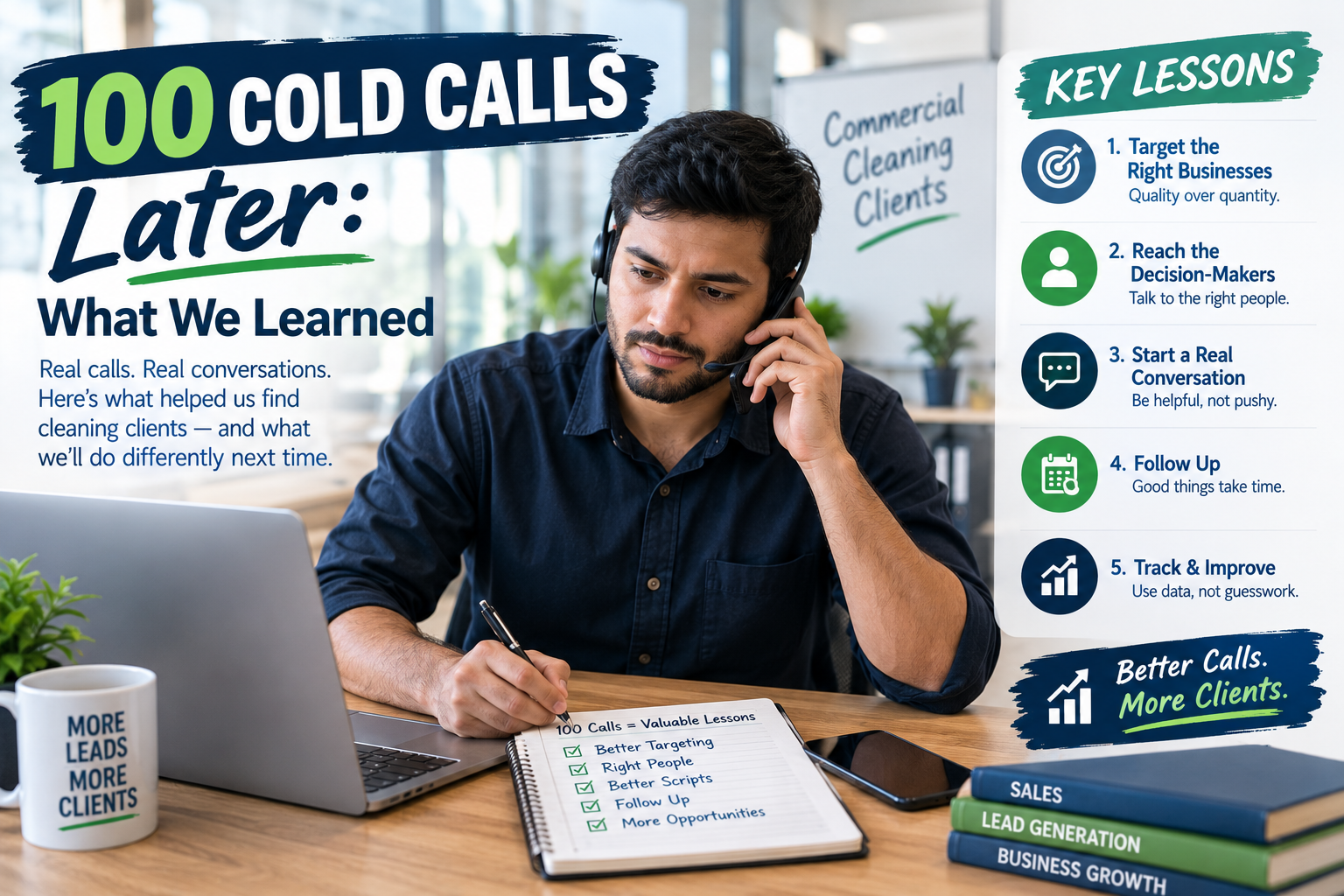
If we were starting another campaign from scratch, we’d focus on five things.
1. Better Prospect Research
Spend more time identifying businesses that match the ideal customer profile.
2. Better Decision-Maker Data
Know who is most likely to handle cleaning decisions.
3. Shorter Openings
Get to the reason for the call quickly.
4. Better Qualification
Don’t confuse a conversation with a qualified lead.
5. Stronger Follow-Up
Make sure promising opportunities don’t disappear after one conversation.
The Cold Calling Process We Recommend
For cleaning companies, a simple process can look like this:
Step 1: Choose Your Market
Decide which industries and locations you want to target.
↓
Step 2: Build Your Prospect List
Find businesses that match your ideal customer.
↓
Step 3: Identify Decision-Makers
Find facility managers, property managers, owners, or other relevant contacts.
↓
Step 4: Make the Call
Use a short, professional opening.
↓
Step 5: Ask Questions
Understand the prospect’s current situation.
↓
Step 6: Qualify
Determine whether there is a legitimate opportunity.
↓
Step 7: Follow Up
Continue the conversation when appropriate.
↓
Step 8: Book an Appointment
Move qualified prospects toward a consultation or walkthrough.
↓
Step 9: Track Results
Measure every stage of the campaign.
↓
Step 10: Improve
Use the data to make the next 100 calls better.
What 100 Cold Calls Really Teach You
The biggest lesson isn’t that cold calling is easy.
It isn’t.
You’ll encounter:
- People who aren’t interested
- People who already have providers
- Wrong numbers
- Gatekeepers
- Busy decision-makers
- Prospects who ask you to call later
- Prospects who never respond
That’s normal.
The important thing is to learn from every conversation.
Every call gives you information.
Every objection tells you something.
Every qualified lead teaches you what your ideal customer looks like.
And every appointment shows you what is working.
Cold Calling Is About Consistency
One hundred calls can produce useful information.
But sustainable lead generation requires consistency.
Think about the difference between:
100 calls once
and
100 calls every week.
The second approach creates an ongoing sales activity.
That’s what cleaning companies need when they’re serious about building a predictable pipeline.
The objective isn’t to make one large push and stop.
It’s to create a repeatable process.
How Lead Generation Fits Into the Process
Many cleaning company owners are already busy managing their operations.
They may not have enough time to:
- Research prospects
- Build lists
- Make hundreds of calls
- Identify decision-makers
- Follow up
- Track conversations
A dedicated lead-generation campaign can handle much of this prospecting work.
The cleaning company can then focus on the opportunities that actually fit its services.
A typical process might look like:
Research → Cold Call → Qualify → Follow Up → Appointment → Proposal → Contract
The goal is to create more opportunities for the cleaning company to sell.
Final Thoughts
After 100 cold calls, one thing becomes clear:
Cold calling isn’t about dialing the most numbers.
It’s about building a better process.
Call the right businesses.
Reach the right people.
Use a natural conversation.
Ask good questions.
Qualify opportunities.
Follow up.
Track your results.
Then make the next 100 calls better than the last 100.
For cleaning companies trying to grow, consistent outbound lead generation can provide something extremely valuable:
More opportunities to talk to potential commercial clients.
And sometimes, the difference between a slow month and a great month starts with something as simple as making the next call.