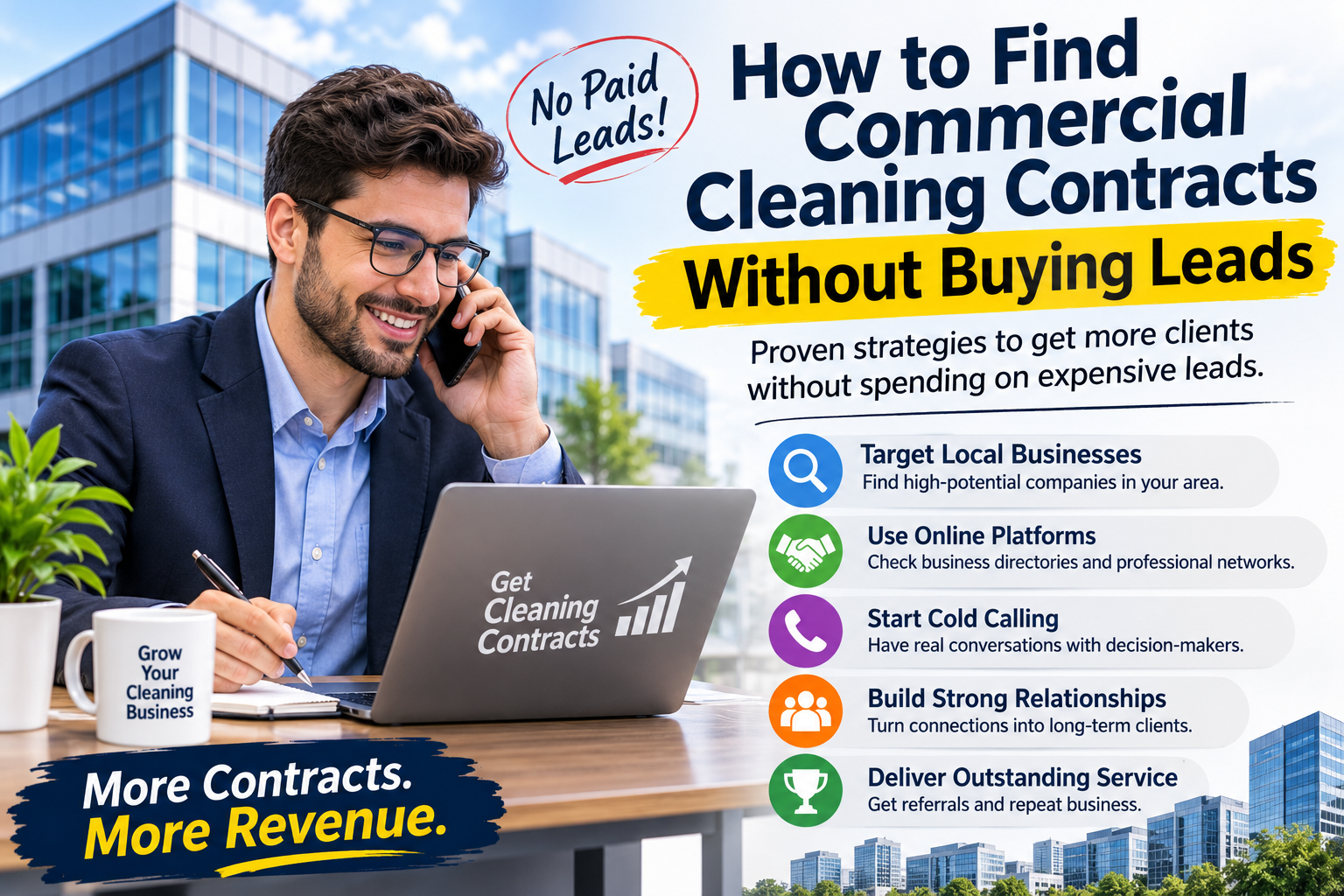
Finding commercial cleaning contracts is one of the biggest challenges for cleaning companies. Many business owners turn to paid lead platforms because they want a faster way to find potential clients.
But buying leads isn’t the only way to grow a commercial cleaning business.
You can build your own prospect list, contact businesses directly, develop relationships with decision-makers, use local networking, and create a repeatable sales system that generates opportunities without paying for every individual lead.
In this guide, we’ll show you how to find commercial cleaning contracts without buying leads and how to turn those opportunities into long-term clients.
Why Stop Buying Commercial Cleaning Leads?
Paid leads can be useful, but they can also create several problems.
You may receive a lead that has already been contacted by multiple cleaning companies. Some leads may not be ready to switch providers, while others may not fit your service area or pricing.
You also have limited control over the type of businesses you’re targeting.
When you generate your own prospects, you control:
- Which businesses you contact
- Which cities you target
- Which industries you focus on
- Which decision-makers you reach
- How often you follow up
- How you present your cleaning company
- How many prospects enter your sales pipeline
Instead of waiting for a lead to arrive, you actively create your own opportunities.
1. Build Your Own List of Local Businesses
One of the simplest ways to find commercial cleaning prospects is to build your own business list.
Start with businesses in your service area that are likely to need recurring cleaning.
Examples include:
- Office buildings
- Medical offices
- Dental offices
- Warehouses
- Retail stores
- Restaurants
- Gyms
- Schools
- Churches
- Property management companies
- Manufacturing facilities
- Apartment communities
- Professional offices
You don’t need thousands of businesses to get started.
A list of 100–200 well-targeted companies can be more useful than a large list of random businesses.
What Information Should You Collect?
For each prospect, try to identify:
| Information | Why It Matters |
|---|---|
| Business name | Identifies the prospect |
| Location | Confirms your service area |
| Industry | Helps personalize your approach |
| Phone number | Allows direct outreach |
| Website | Helps you research the company |
| Decision-maker | Gets you closer to the person who can approve cleaning services |
| Useful for follow-up | |
| Current situation | Helps you understand potential needs |
The goal isn’t simply to collect phone numbers.
The goal is to build a list of businesses that could realistically become cleaning clients.
2. Target the Right Decision-Maker
Calling a business is not enough.
You need to reach the person responsible for hiring or managing cleaning services.
Depending on the type of business, this could be:
- Facility Manager
- Office Manager
- Property Manager
- Operations Manager
- General Manager
- Building Manager
- Owner
- Administrative Manager
- Procurement Manager
For example, if you’re calling a large office building, asking the receptionist to “speak with someone about cleaning” may not get you very far.
Instead, you can ask:
“Hi, who handles your facility or cleaning services?”
This sounds simple, but identifying the right person can dramatically improve your outreach.
3. Use Google to Find Potential Cleaning Clients
Google can become one of your best prospecting tools.
Search for businesses in your target cities and industries.
For example:
- “office buildings in Dallas”
- “medical offices in Houston”
- “warehouses in Atlanta”
- “property management companies in Chicago”
- “dental offices in Phoenix”
- “manufacturing companies in Denver”
Create a prospect list from businesses that match your ideal customer profile.
You can then research each company before contacting them.
This gives you an advantage because your outreach becomes more relevant.
Instead of saying:
“We provide cleaning services. Do you need cleaning?”
You can start a more professional conversation based on the business you’re contacting.
4. Prospect Through Google Maps
Google Maps can also be extremely useful for local prospecting.
Search for specific business categories in your target city.
For example:
“Commercial offices near me”
or:
“Warehouses in Dallas”
You’ll find businesses that may need recurring cleaning services.
Create a spreadsheet and record the businesses that fit your target market.
Then research their websites and identify the appropriate contact person.
This creates a simple prospecting system without purchasing individual leads.
5. Use Cold Calling to Create Your Own Opportunities
Cold calling is one of the fastest ways to proactively reach potential commercial cleaning clients.
Instead of waiting for someone to submit a form, you start the conversation.
A simple opening might be:
“Hi, this is [Name] with [Company]. I’m reaching out because we work with businesses in the area on their commercial cleaning needs. Who would be the best person to speak with about your facility cleaning?”
The goal of the first call isn’t necessarily to close the contract.
Your goal may simply be to:
- Reach the right person
- Start a conversation
- Determine whether they have a need
- Find out when their current arrangement changes
- Book an appointment
- Schedule a follow-up
That’s why effective cold calling is more about starting conversations than aggressively selling.
6. Don’t Try to Sell Everyone
One common mistake is treating every business as a potential client.
Not every prospect is a good fit.
Before spending significant time on a prospect, consider:
- Does the business need commercial cleaning?
- Is it inside your service area?
- Is the facility large enough?
- Does the company outsource cleaning?
- Are they unhappy with their current provider?
- Is their contract ending soon?
- Do they have multiple locations?
- Can they afford your service?
The better you qualify prospects, the less time your sales team wastes.
7. Find Businesses That May Be Switching Cleaning Companies
One of the best prospects is a business that already understands the value of professional cleaning but isn’t satisfied with its current provider.
Possible signs include:
- Poor service
- Missed cleaning schedules
- Quality complaints
- Lack of communication
- Staffing problems
- Inconsistent results
- Contract expiration
- Expansion into a new facility
- A new property manager
- A recently opened location
You don’t necessarily need to convince these companies that they need cleaning.
They already understand the need.
Your job is to show them why your company could be a better option.
8. Build Relationships With Property Managers
Property management companies can be extremely valuable for commercial cleaning businesses.
One relationship can potentially lead to opportunities across multiple properties.
Instead of approaching property managers only when you need a contract, start building relationships before you need one.
You can introduce your company and ask:
“Do you keep a list of approved cleaning vendors for your properties?”
If they do, ask about their vendor requirements and application process.
You may need:
- Insurance documentation
- Business license
- References
- W-9
- Background checks
- Safety documentation
- Service capabilities
- Pricing information
Getting onto a vendor list can create opportunities later when a property needs a new cleaning provider.
9. Network With Local Business Owners
Not every commercial cleaning contract starts with a cold call.
Networking can also create opportunities.
Consider attending:
- Local business networking events
- Chamber of Commerce events
- Property management meetings
- Real estate networking events
- Business conferences
- Local industry events
Don’t approach networking as:
“I need a cleaning contract.”
Instead, focus on building relationships.
The person you meet today may not need cleaning services.
But they might know a property manager, office owner, or business executive who does.
10. Ask Existing Clients for Referrals
Your current customers can become one of your strongest sources of new business.
If you provide excellent service, ask satisfied clients whether they know another business that could benefit from your services.
For example:
“We’re always looking to help more businesses in the area. If you know another company that needs reliable commercial cleaning, we’d really appreciate an introduction.”
A referral can be easier to convert because the prospect already has some level of trust.
You can also create a simple referral program if it makes sense for your business.
11. Create a Professional Website
Your website doesn’t directly replace prospecting, but it can significantly affect what happens after someone hears about your company.
Imagine you call a business and the decision-maker says:
“Send me your information.”
They may search for your company online.
If your website looks outdated, contains little information, or doesn’t clearly explain your services, you may lose credibility.
Your website should clearly communicate:
- What services you provide
- Which industries you serve
- Your service areas
- Why businesses should choose you
- Your experience
- How to contact you
- How to request a quote
Your website should work as a 24/7 sales asset.
12. Use LinkedIn for B2B Prospecting
LinkedIn can be particularly useful for commercial cleaning companies targeting decision-makers.
Search for people with titles such as:
- Facility Manager
- Property Manager
- Operations Manager
- Office Manager
- Facilities Director
- General Manager
Instead of immediately sending a sales pitch, consider connecting first.
You can share useful information about commercial cleaning, facility maintenance, workplace cleanliness, and related topics.
Over time, this can help establish your company as a professional service provider rather than just another company sending a sales message.
13. Use Email Follow-Up
A prospect who says “not right now” isn’t necessarily a permanent rejection.
Timing matters.
A company may already have a cleaning provider today but need a replacement six months from now.
That’s why follow-up is critical.
A simple follow-up schedule could look like:
Day 1: Initial call
Day 3: Follow-up email
Day 7: Second call
Day 14: Follow-up
Day 30: Check in again
Every 30–60 days: Stay in touch with high-value prospects
Your exact schedule can vary, but the important thing is consistency.
14. Create a Commercial Cleaning Sales Pipeline
Don’t keep prospect information in your head.
Use a spreadsheet or CRM to track every opportunity.
A simple pipeline could contain:
New Prospect → Contacted → Decision-Maker Reached → Qualified → Appointment → Proposal → Negotiation → Won/Lost
This makes it easier to understand what’s happening with your sales efforts.
For example, if you contact 200 businesses and only 5 become qualified opportunities, you know you need to improve targeting or messaging.
If you generate many appointments but very few contracts, your problem may be pricing, proposals, service presentation, or closing.
Tracking the numbers helps you identify the real problem.
15. Focus on Recurring Contracts
Not all cleaning work is equally valuable.
A one-time cleaning job can generate immediate revenue.
A recurring commercial cleaning contract can create predictable monthly revenue.
For example, imagine a contract worth:
$2,500 per month
Over one year:
$2,500 × 12 = $30,000
One contract can therefore represent a significant amount of annual revenue.
This is why commercial cleaning companies should focus their sales efforts on businesses that can potentially become long-term recurring clients.
16. Build a Repeatable Outreach System
The biggest advantage of generating your own prospects is that you can build a system around it.
For example:
Step 1: Choose a market
Pick a city or group of cities.
Step 2: Choose an industry
Focus on offices, medical facilities, warehouses, restaurants, or another profitable segment.
Step 3: Build your prospect list
Find businesses that fit your ideal customer profile.
Step 4: Identify decision-makers
Find the person responsible for cleaning or facility management.
Step 5: Start outreach
Use phone calls, email, LinkedIn, and networking.
Step 6: Qualify prospects
Determine whether the business has a genuine opportunity.
Step 7: Book appointments
Move qualified prospects into your sales pipeline.
Step 8: Send proposals
Create professional proposals based on the prospect’s requirements.
Step 9: Follow up
Don’t assume silence means rejection.
Step 10: Close and retain
Win the contract and provide excellent service.
This creates a repeatable client acquisition machine.
Buying Leads vs Generating Your Own Prospects
Here’s a simple comparison:
| Buying Leads | Generating Your Own Prospects |
|---|---|
| Pay for individual opportunities | Build your own prospect database |
| Limited control over lead quality | Control who you target |
| Leads may be shared | Direct prospecting |
| May compete with other providers | You control your outreach |
| Can become expensive at scale | Prospecting can be repeated |
| Less control over timing | You choose when to contact prospects |
| Depends on lead providers | Builds your own sales system |
This doesn’t mean paid leads are always bad.
They can be useful for companies that need immediate opportunities.
But you shouldn’t have to depend entirely on purchased leads to grow.
How Much Can You Save by Generating Your Own Prospects?
The answer depends on your sales process and how efficiently you convert prospects into clients.
Suppose a company spends hundreds or thousands of dollars every month purchasing leads.
Instead, that company could invest those resources into:
- Prospect research
- Cold calling
- Appointment setting
- Email outreach
- Sales training
- CRM software
- Follow-up
- Website improvements
The goal isn’t simply to spend less.
The goal is to build an acquisition system that becomes more predictable over time.
The Real Secret: Consistency
Most cleaning companies don’t fail because they don’t know how to find potential clients.
They fail because they don’t consistently prospect.
They might make 20 calls one day, stop for a week, make another 30 calls, and then stop again.
That’s not a sales system.
A better approach is consistent daily activity.
For example:
50 targeted prospects per day × 5 days = 250 prospects per week
Over four weeks:
250 × 4 = 1,000 prospecting opportunities
Your actual results will depend on your market, targeting, offer, outreach quality, and follow-up.
But consistent activity gives your business something extremely important:
A predictable sales pipeline.
What If You Don’t Have Time to Cold Call?
This is where many cleaning company owners get stuck.
They know they need more clients, but they’re already busy managing:
- Employees
- Cleaning schedules
- Customers
- Equipment
- Payroll
- Quality control
- Operations
Sales prospecting gets pushed to the bottom of the list.
If that’s your situation, you don’t necessarily need to do every cold call yourself.
You can outsource appointment setting to a trained cold-calling team.
Instead of paying for individual leads, you can have agents consistently prospect businesses, speak with decision-makers, qualify opportunities, and schedule appointments.
The important thing is to choose a team that understands commercial cleaning and can represent your company professionally.
Final Thoughts
You don’t need to buy every lead to find commercial cleaning contracts.
You can build your own pipeline by:
- Researching local businesses
- Targeting specific industries
- Finding decision-makers
- Using Google and business directories
- Making targeted cold calls
- Sending personalized emails
- Building relationships with property managers
- Using LinkedIn
- Networking locally
- Asking existing customers for referrals
- Following up consistently
- Tracking your sales pipeline
The biggest advantage is control.
Instead of waiting for someone to sell you a lead, you can actively create your own opportunities.
And when you build a repeatable prospecting system, your cleaning company isn’t dependent on referrals or expensive lead platforms alone.
More prospects. More conversations. More appointments. More opportunities to win recurring commercial cleaning contracts.
Need Help Finding Commercial Cleaning Prospects?
If you don’t have the time or staff to handle daily prospecting, professional cold calling and appointment setting can help keep your sales pipeline active.
A trained team can research prospects, contact businesses, speak with decision-makers, qualify opportunities, and schedule appointments for your cleaning company.
The objective isn’t simply to make more calls.
It’s to create real commercial cleaning opportunities that can turn into long-term contracts.